
Frozen Embryo Transfer (FET)
Frozen embryo transfer is a lighter treatment than a full IVF cycle, because it does not require ovarian stimulation medication or egg collection. The key to successful treatment is preparing the uterine lining to receive the embryo and timing the transfer precisely.
How is frozen embryo transfer carried out?
A frozen embryo transfer can be performed during a natural menstrual cycle, a medically supported cycle, or a cycle prepared entirely with hormone medication. The most suitable approach is chosen based on the menstrual cycle, ovulation and previous treatment history.
1. Frozen embryo transfer in a natural cycle
If menstrual cycles are regular and ovulation occurs normally, the transfer can be carried out in a natural cycle.
The development of the uterine lining and the growth of the follicle are monitored by ultrasound. If needed, the timing of ovulation can be clarified with hormone tests or ovulation tests. The transfer is timed according to ovulation, so that the uterine lining is as receptive as possible to the embryo.
2. Frozen embryo transfer in a medically supported cycle
If needed, medication can be used to support the natural cycle and allow the timing of ovulation and embryo transfer to be controlled more precisely.
Follicle growth is monitored by ultrasound, and ovulation can be triggered with an injection (Ovitrelle or Gonasi). Medication to prevent premature ovulation (Ganirelix) may also be used if needed.
This is the most commonly used approach at Dextra. It allows the transfer to be timed precisely and reduces the risk of missing the optimal transfer window.
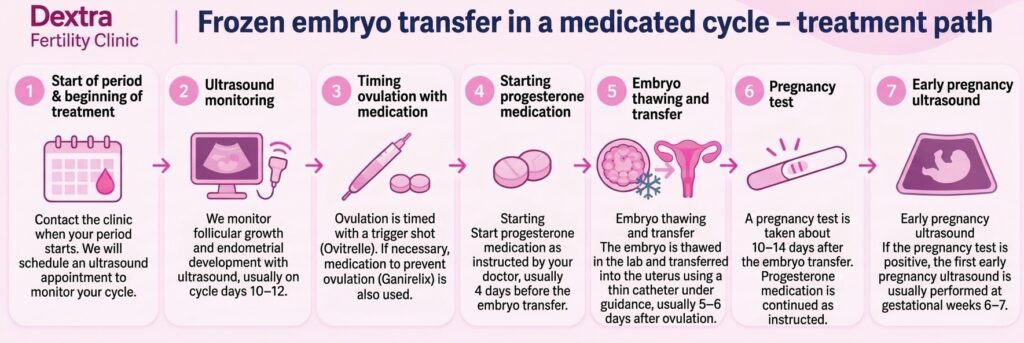
3. Frozen embryo transfer in a hormone replacement cycle
If menstrual cycles are irregular or ovulation does not occur, the transfer can be carried out in a cycle prepared entirely with hormone medication.
The uterine lining is developed with oestrogen medication, followed by progesterone. The timing of the transfer depends on when progesterone is started and on the embryo’s stage of development.
What should be considered during embryo transfer?
For an embryo to implant, the uterine lining needs to be receptive at the time of transfer. Precise timing of ovulation or the start of progesterone medication is therefore an important part of treatment. The structure, development and function of the uterine lining also affect the conditions for implantation.
At Dextra, we monitor the development of the uterine lining with ultrasound and use medication when needed to help ensure the transfer is timed correctly. If previous transfers have not resulted in pregnancy, more detailed testing of endometrial receptivity (beREADY, ERA) may be considered in some cases.
The immune system in the uterine lining also plays an important role in implantation and early pregnancy. Immune cells help regulate the lining’s function and support the conditions needed for implantation. Our clinic can investigate immunological factors in the uterine lining.
If previous embryo transfers have not resulted in pregnancy, we assess possible underlying factors and whether further investigations may be needed. The aim is to time the transfer as precisely as possible and create the best possible conditions for implantation.
How is the embryo transferred?
Before the transfer, the embryo is thawed in the laboratory. We use rapid vitrification to freeze embryos. With this method, more than 95% of frozen blastocysts remain viable after thawing.
During the transfer, the embryo is placed in the uterine cavity using a thin, soft catheter under ultrasound guidance. The procedure is usually quick and almost painless.
Usually, one embryo is transferred at a time to keep the risk of a multiple pregnancy as low as possible.
What happens after embryo transfer?
After the transfer, any prescribed progesterone or other hormone medication is continued as directed by the doctor. Progesterone supports the function of the uterine lining and embryo implantation.
A pregnancy test is usually taken about 10–14 days after the transfer. If the result is positive, an early pregnancy ultrasound is arranged, usually at 6–7 weeks of pregnancy.
What affects the success of frozen embryo transfer?
The success of frozen embryo transfer depends particularly on the embryo’s quality and chromosomal status, as well as the receptivity of the uterine lining.
The woman’s age at the time of egg collection is also an important factor. A frozen embryo retains the age-related characteristics associated with the eggs at the time they were collected, even if the embryo is transferred to the uterus years later.
If needed, the embryo’s chromosome number can be examined using preimplantation genetic testing (PGT-A). Based on the test results, this can help select an embryo with a chromosomally normal result for transfer. The potential benefit of testing is assessed individually.